Rhythm Words — Rhythm Game for Kids
Free on iPhone and iPad (iOS 17 or later). Say the word, tap its syllables, and the next grove opens when most taps land in time.
Every fruit is a rhythm. Pear is one note, ap-ple is two, straw-ber-ry is long-short-short, wa-ter-mel-on is four. Listen to the bar — then clap it back. Want more on a phone or tablet? Rhythm Words turns the same idea into a free iOS rhythm game for kids aged 6–8.
Tap a fruit to drop it on the glowing beat — it moves along on its own. The link in your address bar saves your rhythm.
One bar to listen 👂, one bar to clap it back 👏 — it loops until you press Stop. Nothing is recorded or scored.
Each fruit’s syllables are its rhythm. Tap any one to hear its rhythm and its name.
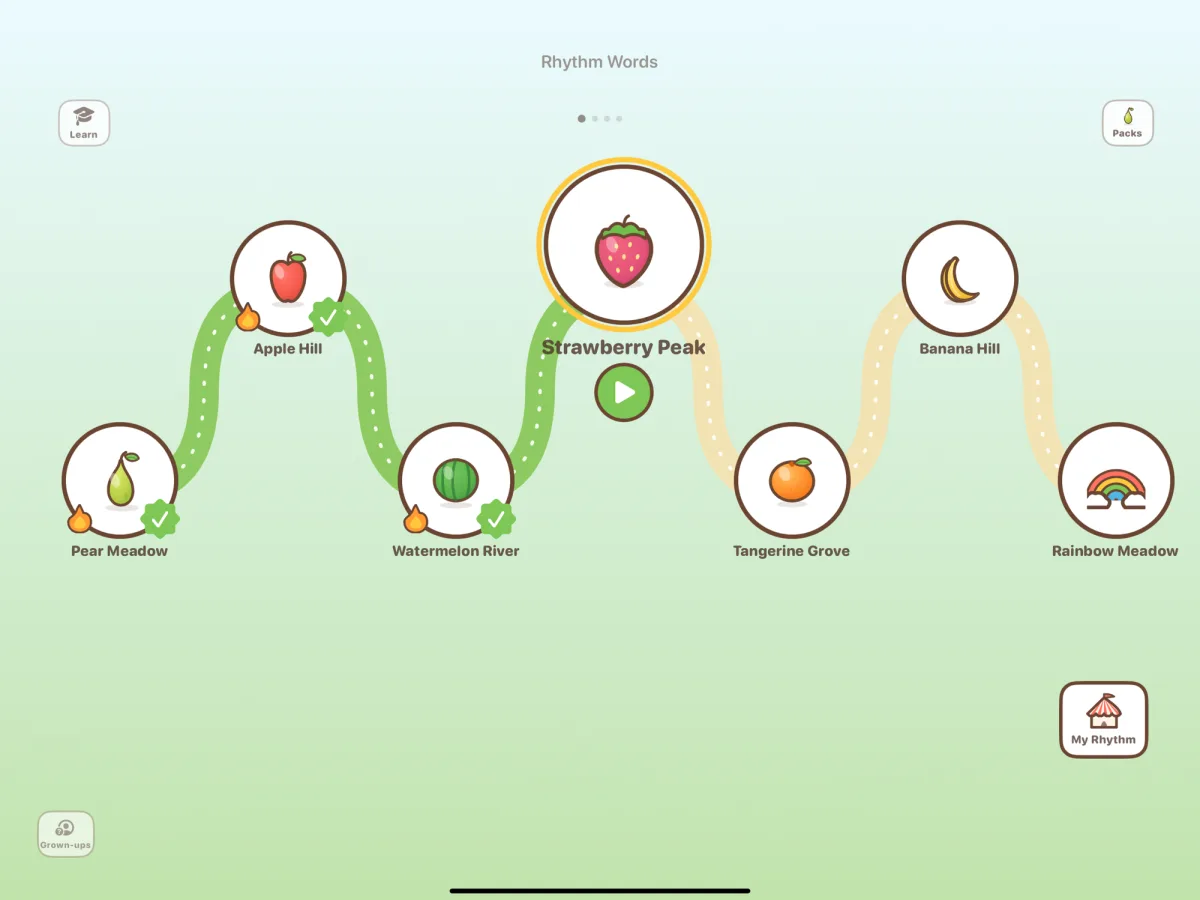
Fruit Rhythms is the taster. Rhythm Words is the same word-rhythm method as a complete course for children aged 6 to 8: seven groves from quarter notes to sixteenths, Pippo the chick hopping along the branches, every tap measured to the millisecond, and an honest timing report for grown-ups behind a parental gate. The whole course is free — no ads, no subscriptions, no tracking.
Free on iPhone and iPad (iOS 17 or later). Say the word, tap its syllables, and the next grove opens when most taps land in time.
Children can say “watermelon” years before they can count “one-e-and-a”. That’s the whole trick: give every beat a word, and let the word’s syllables be the rhythm. The mouth already knows how to divide a beat evenly — we’re just borrowing that skill and pointing it at music. Teachers have used this for decades (it’s the idea behind the Kodály and Orff rhythm syllables); fruit simply makes it delicious.
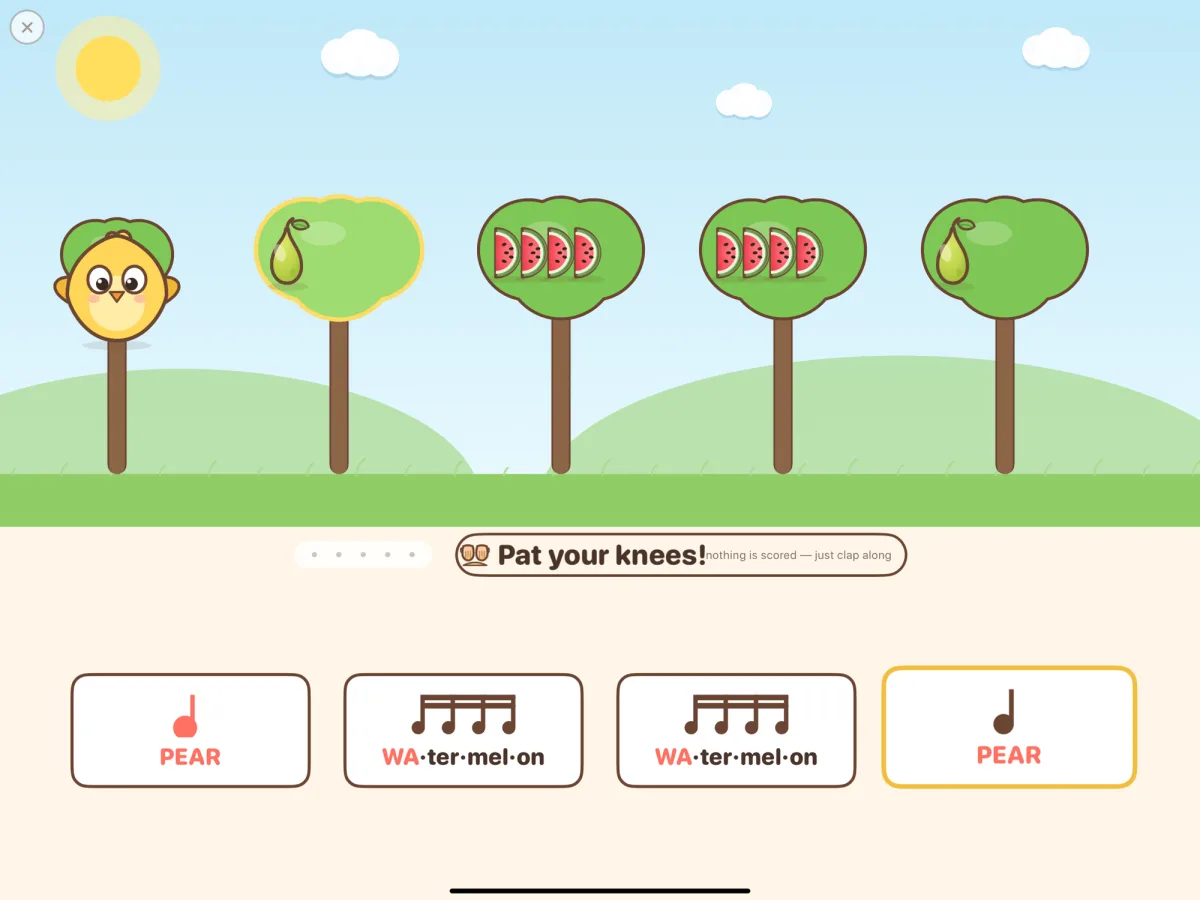
One syllable fills the beat with a single quarter note. Two syllables split it into eighths. Four even syllables make sixteenths, and a beat with no word at all is a rest. Because every fruit lasts exactly one beat, four fruits make one bar of 4/4 — and a child is reading a bar of music without anyone mentioning the word “notation”.
Three syllables are the interesting case, and we don’t cheat it. Say them out loud: ba-NA-na and to-MA-to come out evenly — that’s a true triplet. But STRAW-ber-ry, BLUE-ber-ry, PINE-ap-ple and CO-co-nut don’t: the first syllable is long and the last two are quick — long-short-short. The giveaway is where the stress lands: only a word stressed on its last syllable, like tan-ge-RINE, turns around into short-short-long. And tan-ge-RINE is the mirror image, two quick syllables leaning into a long one — short-short-long. Squeezing them all into an even triplet would teach a child a rhythm their own mouth disagrees with, so each fruit here gets the shape English actually gives it.
You do — and that’s on purpose. Browsers can speak a word, but they can’t place its syllables on a beat: the speech engine starts when it feels like it and every device talks at its own speed. A voice that drifts would teach the wrong rhythm, so we don’t use one inside the bar — the clicks and the ball carry the rhythm exactly, and the printed syllables are your script to chant along with. (Tap a fruit in Meet the fruits and it will happily say its name — there’s no beat to miss there.) Recorded voices that land on every syllable are a job for the app.
When clapping back feels easy, move up to the rhythm trainer, where one beat of the bar changes every measure and there are no pictures to lean on. Older kids and teens who want to know how tight their timing actually is can try the timing test, and everything sounds better practised against a steady metronome.
Give every beat a word and let the word’s syllables be the rhythm. One syllable fills the beat with a single quarter note (pear) and two syllables split it into eighths (ap-ple). With three syllables the word’s stress decides: ba-NA-na is evenly stressed so it is a true triplet, while STRAW-ber-ry is long-short-short. Four even syllables make sixteenths (wa-ter-mel-on). Children say the word long before they can read notation, so the rhythm arrives through language instead of counting.
A bar of four fruits appears. After a count-in the bar plays: you hear the metronome and a click for every note, while a bouncing ball lands on each note in turn so a child can see the rhythm as well as hear it. Then the metronome keeps going for one more bar — that is the child’s turn to clap or say the same rhythm back. It loops so they can try again. There is no microphone and no score.
Roughly four to eleven. Start on Easy, which uses only one- and two-syllable fruits — quarter notes and eighths — at a slow tempo. Medium adds wa-ter-mel-on sixteenths, the long-short-short of straw-ber-ry and the short-short-long of tan-ge-rine, and Tricky adds even triplets (ba-na-na) and silent rest beats. Every bar is guaranteed to contain the rhythm its level is there to teach.
No. The fruit picture and its syllables carry the rhythm on their own. The real notation sits above each fruit so children absorb what a quarter note, an eighth pair, a triplet and sixteenths look like without being taught it directly.
Seven building blocks of simple rhythm: one quarter note (pear, grape, peach), two eighth notes (ap-ple, cher-ry, man-go, ki-wi, lem-on), long-short-short (straw-ber-ry, blue-ber-ry, pine-ap-ple, co-co-nut), short-short-long (tan-ge-rine), an even triplet (ba-na-na, to-ma-to), four sixteenth notes (wa-ter-mel-on, a-vo-ca-do) and a silent rest beat (shh).
The rhythm trainer reads a real 4/4 bar where one beat changes every measure.